Surviving a Bird Strike in an RV6
by John Perri, RV6, N345JE

It was just going to be a routine check flight of my RV-6 Experimental Aircraft. The
weather conditions on the June evening could not have been better with extreme clear and
little or no wind. The flight was conducted to validate the dynamic propeller balance
which had been performed on the plane an hour earlier. I wanted to complete the flight
early that evening due to the large number of bugs which swarm at dusk bringing with them
an equally large number of hungry birds. Initially the flight was conducted at Bountiful
Skypark (BTF) just north of Salt Lake City in and above the traffic pattern without
incident. Little did I realize that this flight was going to be anything but routine!
All systems looked good and I decided to execute a touch and go on runway 34 if the
cylinder and oil temps were in the green. On base to final I noticed the oil temperature a
little high and decided to go around to see if the temp would drop with one more lap
around the pattern. At approximately 100-150 feet altitude and one third of the way down
the 5000 foot runway, I caught a glimpse of an object coming straight at me at eye level.
I leaned hard left, then heard and felt something come through the canopy, leaving a
softball size hole right in front of me. I immediately throttled back to land and then saw
much of the remaining canopy blow away from the craft causing a large rush of air and much
noise. I then realized that my head set had been knocked almost completely off and there
was blood covering the right lens of my sunglasses.
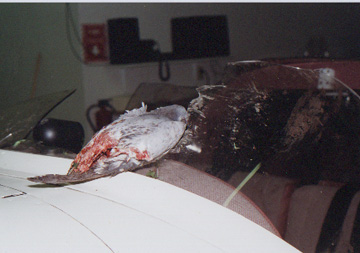
By now I was well down the runway and decided a normal landing would be
difficult and most likely end in over-running the north end of the runway which is bounded
by a fence, ditch and road. Over-running the road would result in an altercation with
several large gas tanks. While throttling up and making a climbing right turn for a
go-around the engine popped and the vibration became more severe. My vision was becoming
impaired from the bird residue and a lot of blood. Later I came to realize that I
was the source of most of the blood, since the shattering Plexiglas had inflicted a deep
bleeding wound in my forehead. I looked for an alternate landing spot east of the field,
but found nothing but homes, businesses and more gas refineries which obviously did not
seem to be a good option for an emergency landing.
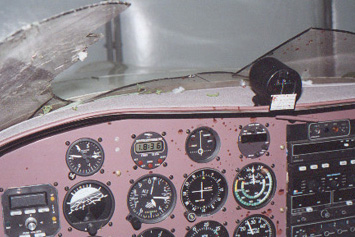
As a flight instructor, I always teach my students to concentrate on a
safe landing, and worry about damage to the plane later. I discovered this is easier to
teach/preach than execute when your own pride and joy is the subject of an impending
crash. I decided to land straight ahead to the north in a field I had walked some time
previously while finding a good landing spot in case of engine failure while flight
testing a friend's new RV-6A. Holding minimum power to reduce vibration I landed on a
northeast heading to maximize the length of the alfalfa hay field. The hay was very tall
and as luck would have it, was harvested two days after I converted the field into an
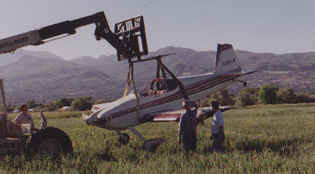
emergency airport. I maintained control during the entire landing until just prior to
stopping. The plane came to an abrupt stop, tipping over on its back.
Once I realized my beautiful RV6 was actually going to overturn, I leaned as far right as
possible which proved to be fortunate since the ground was soft and the remainder of the
canopy sunk in further than I anticipated. With some difficulty I released myself from the
harness and tried to exit the plane on the side with the most canopy damage. This proved
unsuccessful so I kicked out more Plexiglas on the other side and dug my way from under
the wreckage. I quickly assessed the damage as well as I could with one functioning eye
and found no fuel or oil flowing from the inverted craft. Since there was nothing more I
could do for my crippled RV at the time, I began walking back to the airport for help.
Help quickly found me in the form of a guy I never saw again (thank you, whoever you are!)
who drove up and gave me a handful of rags and a suggestion to tend to that nasty wound on
my head. Soon a cast of thousands arrived including several friends and the local police
and paramedics. As always I felt that I had the situation in total control and told them I
was fine, after which I signed form after form declining medical treatment. Later that
evening, a friend took me to an emergency room in Salt Lake for a late night stitching
ceremony performed by a plastic surgeon as my always supportive wife Shelli stood close
by.
After a few hours of sleep, I was back out to the "landing" spot to supervise
the removal of my bird (the RV, not the feathered offender) from the field before any more
damage or possible looting could occur. With the help of a good friend who owns a
construction rental company, we lifted the plane, righted it, and transported my bloodied
RV to my hanger so I could really begin to assess the damage. It didn't seem too bad once
I cleaned off the grass, dirt and blood. Several well wishers stopped by the hanger to
evaluate the situation and offer suggestions. I received comments ranging from "this
will be easy to fix" to "total it!" I also was presented with the Trophy
Pigeon which went through the canopy. I later discovered that at least two unwilling
accomplices had hit the prop and lower cowl.
A few hours later I found myself at the local FSDO trying to explain the
events of the previous day . They were quite content with my explanation and only reminded
me that in my haste to extricate myself from the overturned RV I had neglected to turn off
the master switch and the activated ELT. I agreed that I should know better since I teach
emergency procedures to students daily. I also kept trying to explain overturning a
conventional gear aircraft in the process of executing a soft field landing. The FAA
Investigator told me his findings showed that the landing was textbook perfect, and that
prior to stopping, the tall grass filled and broke loose one of the wheel pants causing it
to lock up the right tire. He also stated that "Chuck Yeager could not have kept that
airplane upright!" This served to partially soothe my wounded ego but did nothing to
prepare me for the continuous explanations and justifications for my actions in the months
to follow due to secondguessing by the Monday morning pilots.
The following weeks produced stacks of paper work for the NTSB and even more for my
insurance company and their adjuster during his visit/investigation. I am fortunate that I
kept up my paper work on the aircraft and had a check flight with the FAA the previous
week. Since I purchased this plane already completed and was not the builder, the FAA was
very interested in how the annual inspections and all repairs had been conducted. I had
the proper documentation to show that all work performed on the plane had been
accomplished under the supervision and authorization of an A&P mechanic. The NTSB
wanted everything from my flight logs to records on the ELT battery replacement.
Seven months after the bird strike my craft has still not returned to Salt Lake. Several
major repairs have been in progress since that exciting evening in June. The crankshaft
flange was bent during either the tip over or recovery, which required shipment to Texas
for magna fluxing of all internal parts and straightening. The crank was ground
.0030" undersize, necessitating oversized bearings. In the process of the rebuild, we
also found the camshaft was rusted and decided to replace the oil impellers, housing and
fuel pump.
After waiting months for Lycoming to ship the crank bearings, Superior came through with a
certificated set. Several other major repairs have been accomplished on the aircraft. Both
wings have received new skins with new tips. Obviously a new canopy was fitted, and
elevators, rudder, vertical stab, motor mount/ landing gear, wheel pants, tires and a
replacement of the rear spar carry through have been installed. The entire prop also had
to be replaced (so much for the dynamic balance!). This has been almost as major a
time/money hit as building a new aircraft. We will be hanging the engine soon and after
test flights, will treat the plane to a trip to Tucson for paint.
Between myself and the insurance company, this minor incident has inflicted a $35,000 dent
to the airplane kitty. Wow! Be absolutely sure you do not under-insure your RV, since
repairs and bird strikes are not cheap!
I flew the day following the bird strike in the flight school's twin (you know, get back
on the horse) without incident. I still find myself ducking every time I see a bird in
front of me while flying or driving the car.
With some luck, the swallows in California and my RV-6 will return to its home this
spring.
John Perri 1/17/98
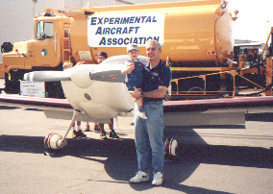
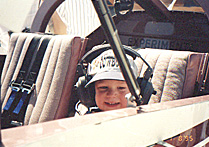
John with his five-year-old son, John Michael, who gave John tons of flack for damaging
"his" plane (or maybe the little fellow saw his college fund dwindling away!)
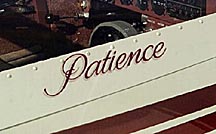
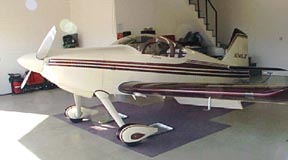
The RV6's nickname is "Patience", a trait that John has certainly had
plenty of time to perfect since his pigeon incident.
Epilog:
The swallows did indeed come back to California in the spring of '98, but my RV remained in Arizona. I was helpless to accelerate this project in order to be ready for spring flying. Many phone calls and more dollars were required to get this project completed. After a visit to Payson, Arizona in May, I became more anxious than ever, since it appeared we were so close. Herb Ross did a remarkable job on the rebuild and every time I tried to push him for early completion he reminded me that quality takes time (and $$$$$$$).
 Next came the big day for the test flight which was delayed for weeks due to a
ramp repavement project at Payson International. The City Council should have checked with
me first. Finally an almost uneventful test flight above the airport then on to Tucson for
paint. I had finished my business with the Artist formally known as Herb Ross, now it was
on to the Paint Maestro at Hotton Aviation.
Next came the big day for the test flight which was delayed for weeks due to a
ramp repavement project at Payson International. The City Council should have checked with
me first. Finally an almost uneventful test flight above the airport then on to Tucson for
paint. I had finished my business with the Artist formally known as Herb Ross, now it was
on to the Paint Maestro at Hotton Aviation.
Don Fisher really knows his stuff, but gave me the bad news that this was going to take longer and cost more that I had expected. So "What’s new?" Some of the original paint was no longer available so we switched to Diamont (diamond dust) Paint. At this point I realized that Oshkosh '98 was going to happen with one less RV-6.
Don called several times about engine starting problems and several other little items. So on July 30 we ventured down to Tucson to help complete the project.
I was speechless when we landed in the mighty Bonanza and saw N345JE sitting on the ramp. A few kind words with the FBO owners and Don the Maestro, and I was ready to fire up the engine. Well, as they reported, there were small problems but soon life flowed back into each cylinder. A quick lunch, several of Don’s stories and some touch-up paint, and I was ready for the real test.
Weather was a little less that ideal but I decided to stay close to the airport and burn some time off the Hobbs. Everything went flawlessly including the landing and an inspection pass behind some Military Iron. After a quick inspection I noticed a more that normal amount of oil on the bottom of the fuselage, but discounted it to the oil accumulator or something even less significant.
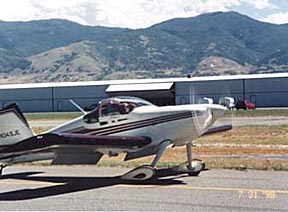
That night I went out to dinner (Mexican, naturally!) with my chase plane pilot Ron and discussed plans for our early departure the following morning to miss all the weather. After a few hours of sleep we showed up at the field early and proceeded to load 5JE with all sorts of baggage, spare paint and other stuff required for the journey back to Utah. With the exception of dodging a few low clouds (didn’t want to get the new paint wet) the flight from Tucson to Page, Arizona was uneventful. A quick refill of the gas tanks (and clean off the oil on the bottom of the fuse) and we were on the way once again. A strong south wind made for a bumpy but quick ride back to Bountiful Sky Park. If you look at the picture of me taxiing back to the hanger, you’re looking at one happy flyer that was glad to have all this behind him.
 The oil leak got much worse on the next flights and lead to removal and
replacement of the prop governor and gasket. I still have not gotten everything back to
normal on Patience. I guess I’m too busy flying to worry about that now.
That’s what winter is for…
The oil leak got much worse on the next flights and lead to removal and
replacement of the prop governor and gasket. I still have not gotten everything back to
normal on Patience. I guess I’m too busy flying to worry about that now.
That’s what winter is for…
Bottom line on the entire incident was 14 months and 50K to undo a little pigeon strike.
Finally I understand what the aircraft name really means...
J. Perri
Back to RV Journal Front Page
Sam Buchanan's RV6 Web Site
Please submit all questions and comments to sbuc@hiwaay.net